Community library
Community library

Team Play
Complete Man To Man Drill
Video by BreakthroughBBall
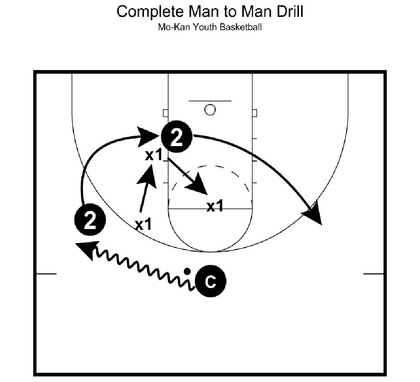
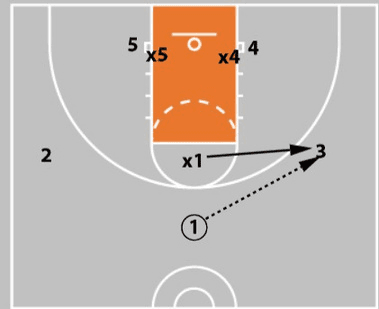
This defensive drill is superb for transitioning between the different positions on the floor to defend many situations. You transition from 1 pass off the ball, 2 passes off the ball positioning, defending the post, defending flash cutters, closing out, and helping on dribble penetration. Also, as a defender, you can’t hide in this drill. You are out on an island and you must fully understand where you should be positioned at all times. Acoach, manager, or player is positioned at the top of the key. A defender (X1) is guarding a player on the wing (2). Coach starts up top with the ball. Defense X1 is in 1 pass away position on the line, up the line. Coach will dribble to the wing and the offensive player 2 will rotate into the post. X1 will take them on in a ¾ front in the post. (Diagram 1) Offense 2 will vacate the post and move the weak side wing. X1 should be in a 2 pass away help position with the ball on the opposite wing with Coach. Offense will flash cut, defense will pick them up and try to force them up the lane to catch away from the paint. If the offense goes back door on the cut, we swivel and pick them up, hand in the passing lane. Once the offense catches the ball, you are live one on one. Up the Line, On the Line – Up the line, on the line means forming a flat triangle, halving it between the ball and the player they are guarding. Have a hand on the imaginary string between the ball and your player. Not past the string, ON it. Past it will get you beat back door, as your body will be too high and out of position. See Player & Ball – When positioned, you should always have your eye on the player with the ball and the player you are guarding. You have to be aware of the ball, so you can position yourself properly to help on defense. You also need to be in the right position, so you can defend your player if a pass is received. If you just watch the ball, it’s easy for your defender to cut to an open spot on the floor for a scoring opportunity. Step In Front Of Cutter – Don’t let the flash cutter receive the pass. Be sure to cut them off. You don’t want any penetrating passes within the 3-point arc. (Diagram 2) Mix Up Cuts & Positions – You can also tell the offensive player to randomly give the defensive player different looks. This is a good progression because it is more game-like as the defender has to react similarly to a game rather than just learn the sequence. You might tell the offensive player to choose three or four different cuts and positions at random. Fake Dribble Penetration – Make sure that the person with the ball fakes dribble penetration periodically throughout the drill. This ensures that the defender is watching the ball and the player they are guarding at the same time. Don’t Depend On Drill – You shouldn’t depend on this drill as a way to defend. The real test is when you are defending with other players on the court. However, it is a good variation to use in practice to initially learn defensive habits. You can also use it as a variation to quickly review defensive principles. Made by Breakthrough Basketball
Team Play
2 on 2 Ball Screens
Video by BreakthroughBBall
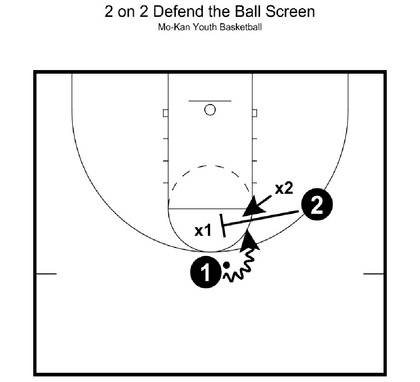
When it comes to the on ball defender and the defender guarding the screener, this is one of the best ball screen drills that you can use. Why? The defenders don’t have any help defense! This makes it way more challenging than during the game. If they can adapt and have success in this situation, your team defense will be that much stronger. There are two offensive players and two defensive players. You are playing 2 on 2. If desired, you can also play 3 on 3. In this diagram, the player with the ball starts at the top of the key. However, you can start from the wing as well. (Diagram 1) The first action at the start of every possession is a ball screen. In this scenario, 2 sets a ball screen. Defender X2 is calling out the screen and jumping to the high side to “hedge” the ball handler east-west. Defender X1 is trying to fight over the top of the screen, and only going underneath if they are caught up in the screen. Next progression is “dribble handoff”. You “switch” on all dribble handoffs as they are normally a guard to guard play. 1 in black would simply dribble to 2 in black and handoff while using the body to shield the ball. Defenders switch on all handoffs. Hedge the Screen – As the player guarding the screener comes up to “hedge the ball screen” (attempt to stop the ball handler from getting north – south), they want to make sure they don’t jump too high over the screen, as this will lead to them being “split” by the ball handler and beaten to the hoop. Stay tight on the screener, step through with your bottom foot over the screener’s top foot and try to force the ball handler up high, away from the hoop. No Straight Lines For Screener – The defender does not allow the screener to easily go where they want. If you can knock the screener off their path, they may not be able to go set the screen. Put a forearm up and stay balanced. Be ready for the screener to initiate contact if they try to continue in a straight line. Beat the Screen – The player guarding the ball needs to stay low. If you are quicker than the ball handler and can avoid the screen, you should try to push the ball handler out without help. If you get caught by the screen and have to go behind, you need to communicate with your helping teammate, let the player know you’re recovered and push your way through to get back on your player. Quickly Reposition On Handoffs – If you’re not aware of your position on the switches for dribble handoffs, you can provide an easy dribble drive opportunity for the ball handler. Make sure to quickly reposition yourself, so your butt is to the basket and you are directly between the ball handler and the basket. 3 on 3 and 4 on 4 – Like mentioned previously, you can play 3 on 3 or even 4 on 4 and start every possession with a ball screen. This is a great way to practice your help defense when it comes to ball screens as well. Offensive Advantage – You could even allow the offense to have an initial advantage on the ball screen to practice scrambling out of help in ball screen situations. Made by Breakthrough Basketball
Team Play
No Paint Drill
Video by BreakthroughBBall
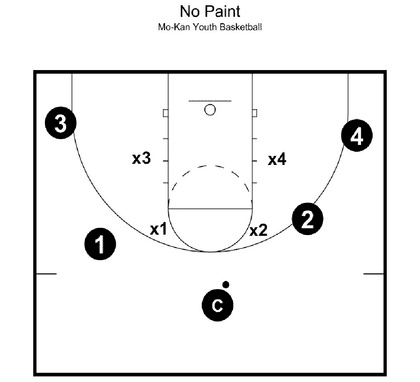
This is one of the best drills at eliminating penetration into the paint! It really develops a mentality of protecting the paint and not letting anybody get in there. Ifyou believe that penetrating via the pass or the dribble is one of the best offensive weapons, this drill is a must! It’salso a great all around defensive drill for practicing proper defensive habits. You have four offensive players. You have four defensive players matched up with the defensive players. Acoach or manager is positioned at the top. (Diagram 1) Coach starts the drill with a pass from the top. The object of the game is to keep the ball from penetrating the paint (lane). Offense gets a point for penetrating the paint on the dribble drive or pass. You can change possession on points scored (in the paint), turnovers, and defensive rebounds. It's just like a regular half court game, except the only way to a point is to get the ball in the lane. (Diagram 2) The first team to 3 wins. Playing to a low number (like 3) makes it really competitive and keeps the intensity at the level you want. 3-Point Shot Hits Rim – A progression would be to add that the offense can score another point by taking a three point shot that hits the rim. This forces defenders to maintain intense ball pressure. Excessive Fouling – You want our players playing hard on defense, but playing smart. Fouling and putting people on the free throw line is unacceptable. It’s not playing smart. The next progression in the drill is to begin awarding points if you are seeing excessive fouling and hand checking to stop the penetration. Make them stop the ball with their feet moving, not their hands reaching. Made by Breakthrough Basketball

Team Play
4v4 With Baseline Drivers
Video by BreakthroughBBall
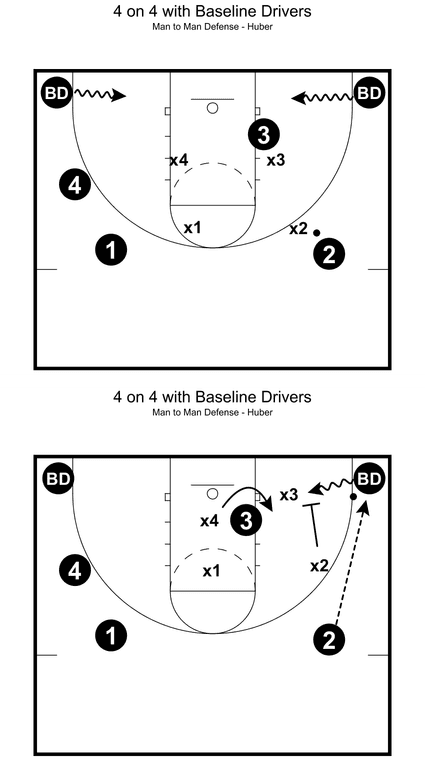
This drill is great for improving your team defense. Specifically, it improves your communication and your team’s ability to help and recover on dribble penetration. Your players have to give 100% effort and focus in order to succeed in the drill. This is a classic example of making practice more difficult than the games. If you can stop the opponent when you’re playing 6 on 4, you know that you can stop them playing 5 on 5. Since you succeed this during practice, you will have the confidence to lock down the opponents during games. There are four offensive players and four defensive players. Additionally, there are two designated baseline drivers (BD) who are positioned in the corners. They are not actively guarded. Baseline drivers can be coaches or players. (Diagram 1) You start the drill. The four offensive players try to score and the four defensive players try to stop them. The baseline driver can choose to drive or pass the ball immediately. If the baseline driver catches and holds the ball, no help is needed. If the baseline driver dribbles to the basket, the defense must stop the ball, communicate, and rotate. As your players begin to understand the rotations and are scrambling well, you can allow the offense to dribble penetrate, do interchanges, etc. This will make the drill much more challenging. See Your Player and the Ball – You must see your player and the ball at all times. If you take your eye off either one, it can result in an easy scoring opportunity for the offense. Help Early & Quick – You must sprint to spots and immediately move once you see the players dribble drive to the basket. If you wait for a split second, it’s too late. Teach When NOT To Help – If one of the guarded players attack the basket, teach your players when they should and should not help. Some coaches teach to help the player when they have a straight line advantage to the goal. If the defensive player is positioned between the player and the basket, don’t help. If the offensive player is not driving directly to the basket, don’t help. Mix Up Drive & Pass – Encourage the baseline driver to mix up between shooting and passing. This will make it more game-like and keep the defense alert and challenge them more. Made by Breakthrough Basketball

Team Play
5v2 Weak Side Help
Video by BreakthroughBBall
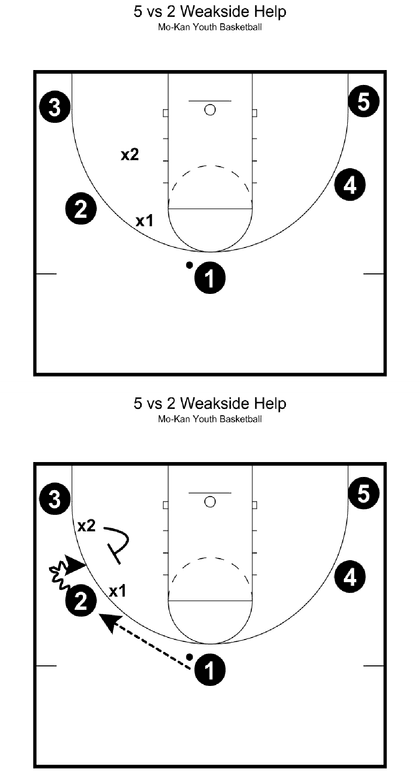
This defensive drill improves your defensive positioning, your ability to defend flash cutters, and communication on interchanges. It’s a great way to isolate two defensive players and take them through a variety of situations. Also, sometimes it can be difficult to see everything when you have four or five players on the floor. This is especially true for new coaches and even seasoned vets can’t see everything. This is agreat way to isolate your players, so you can see precisely what they’re doing and enforce good defensive habits. (Diagram 1) There are five offensive players on the perimeter. There are two defenders that are matched up man to man. X1 is guarding 2 and X2 is guarding 3. When the ball is passed to the wing, you are jumping to the ball. X1 is applying ball pressure and X2 is ready to help seal the seam on the dribble drive (bottom diagram). The ball can be skipped across, in which case the defenders would be jumping with the ball into a help position on the midline, head on swivel, looking for flash cutters. After the skip, the offensive players may flash cut the lane and look for the ball. The offensive players (2 and 3 in black) are allowed to interchange as well. Constant Communication – The two defenders should be in constant communication. That way, they know how to help, recover, and rotate properly. You don’t want two players guarding the ball. Sprint to Areas! Anything less than 100 percent is unacceptable. Get in the habit of going all out in sprinting to where you need to be. Move with the Pass, Not on the Catch – Be anticipatory in movement. Move with the ball as though a magnet was in your chest. Made by Breakthrough Basketball

Team Play
4v4 Shell Drill
Video by BreakthroughBBall
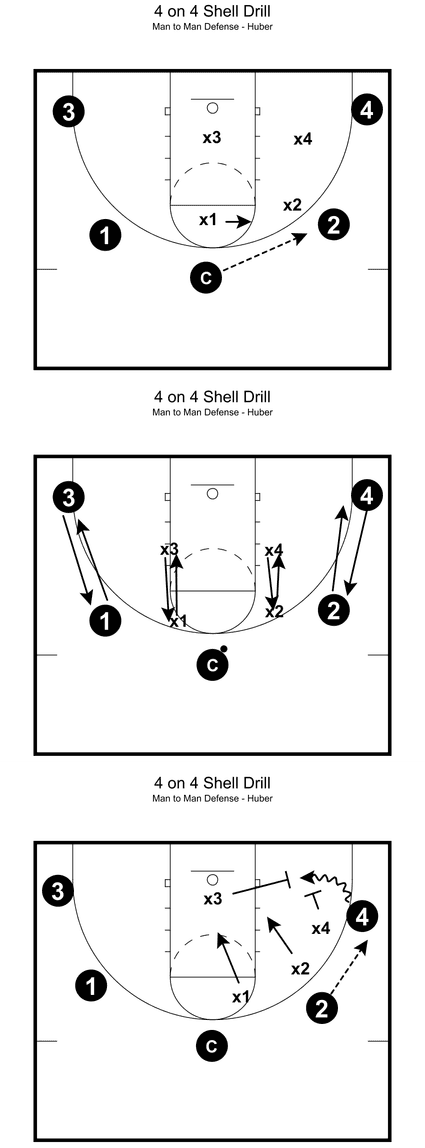
The shell drill is a great tool for teaching your defense. From a big picture perspective, you can quickly teach your players exactly what your team defense should look like. You can practice all of your defensive concepts in a team situation. You work on ball defense, being in a great stance, closing out, jumping to the ball, sprinting areas, and other key defensive concepts. You can practice defending any situation. You can practice defending all types of cuts, screens, and offensive actions. You can practice defending basket cuts, backdoor cuts, flare cuts, down screens, ball screens, back screen, staggered screens, horns sets, Princeton sets, etc. It’s also great because it allows you to be efficient with your team. You can have four or five defenders practicing defense all at once. You can also use the shell drill to work on specific defensive techniques. That way, if you’re struggling with a particular offensive action, you can break it down and make sure your players understand how to defend in that situation. Also, you can get a bunch of reps in a short amount of time to solidify their learning. The following is a beginner progression for teaching the shell drill. You can also see progressions for teaching how to defend down screens and back screens. You position four or five offense players on the court. You position a defender guarding each offensive player. Progression 1 – Positioning Whenyou instruct, “Pass.” Offense passes the ball. You look for correct help positioning, proper close outs, appropriate on-ball defense, and necessary effort. Progression 2 – Interchange This is the same as progression 1, except now you have the players interchange positions from corner to wing when you instruct, “Interchange.” This is a great way to get players defending more positions and situations. Progression 3 – Baseline Drive Now you instruct, “Pass. Skip. Beat Them. Pass Out.” “Pass” indicates that you pass to the person next to you. “Skip” indicates you pass to the player two people away from you. “Beat Them” means that you drive baseline to force help. At first, the on-ball defender will let the ball handler go to practice rotations. (Diagram 1) “Pass Out or Kick Out” means that after the baseline drive, the ball handler turns and passes the ball back out to a perimeter player. Progression 4 – Live You take the defense through the same baseline drive routine as progression 3. You now instruct, “Live!” This means that the offense and defense play basketball. Rotate defense to offense after a predetermined number of “stops” by the defense. The drill can also progress to allowing the offense to rotate and have basket cutters. Progression 5 – Down Screens The drill is set up with 4 offensive (black) and 4 defensive players (numbers), with a coach up top with the ball. The coach will start the drill by passing to one of the players at the elbow. The helpside offensive players will set a predetermined screen. The defense will jump to the ball and work to defend the screen correctly. (Diagram 2) (Diagram 3) (Diagram 4) Once screens are consistently being defended correctly, the drill can be moved to a “live” scenario. Progression 6 – Back Screens The drill is set up with 4 offensive players on the outside and 4 defenders on the inside. Coach is up top with the ball. Coach starts the drill with a pass to the elbow. The offensive player on the weak side block will set a back screen for their teammate on the weak side elbow. Defender X4 will hang back and become “goalie” and defend the lob, seeing cutter and the ball (yellow areas). Once the player who was back screened gets through and recovers, the “goalie” can close out on their player. Jump To The Ball – Make sure we are anticipating the pass and jumping with ball, not reacting to the pass being caught. Move with the ball like you have a magnet in your chest. No Layups – Seal the seams and force the ball outside the scoring area, the area that we consider our “house”. Don’t Hug Your Player – Don’t hug your player when they are going to set a screen. If you hug the player, play too closely, the screener might be able to set a “double” screen and screen you and a teammate at the same time. Stay up the line, on the line from the ball and give the player being screened enough room to get through. Ball Side Of Down Screen – Jim teaches the defenders to go “ball side” of the screen, so we are coming up the middle in a help position. In the bottom diagram, X3 would fight to get around the screen on the ball side where the offense, 1 in black, has received the ball. (Diagram 5) No Lobs – Non Negotiable on Defense – We do not allow LOBS on back screens. Get Skinny On Screens – When your player calls out the screen, get “skinny”. Turn at an angle that makes you more difficult to screen and be ready to move. If you get caught “fat and flat” by that back screen, you are going to have a difficult time recovering and getting round the screen. Demand Great Effort – Be sure they sprint to areas and give maximum effort. Often players think they are giving maximum effort, but they are not. Immediately correct and rep out until the player does this correctly. Playing with great effort can help you overcome a lot of mistakes. Master The Basics / Don’t Rush – When it comes to youth and high school basketball, don’t worry about progressing until you master the basics of positioning, help defense, communication, and effort. If you do these things, it can counter many things that the offense throws at you. Made by Breakthrough Basketball

Team Play
Ball Screen Defense Drill
Video by BreakthroughBBall
The drill starts with 5 offensive players and 3 defensive players. The offensive players are positioned on the blocks and wings. The defensive players are positioned on the blocks and at the top of the key. Be sure to rotate players through multiple spots. The drill starts with the 1 passing the ball to the wing. X1 sprints to cover the wing. 1 is then out of the drill. (Diagram 1) On all 3 reps, the offensive wings should allow X1 to get to them before dribbling. If they go before then, the drill won’t simulate a realistic ball screen situation. On the first rep, the big is in a drop coverage. X1 forces 3 to use the screen (does not allow them to reject the screen). X1 then chases over the top of the screen. X4 stays back to protect against the roll. This coverage protects the paint. It is designed to allow contested mid range pullup jumpers, a low percentage shot. After coming off the screen, 3 passes to 2 on the opposite wing. X4, as well as 3 and 4, return to their original positions. (Diagram 2) (Diagram 3) X1 sprints through to cover 2, who holds the ball until X1 arrives. On the second rep, the defense executes a flat hedge ball screen coverage. In this coverage, x5 moves laterally with the dribbler. As with the first rep, X1 goes over the screen. X5 continues laterally until X1 gets back in front. X1 should communicate to X5 when he can recover to their player. It’s important that X5 have high hands to deter a pass to 5 rolling. (Diagram 4) (Diagram 5) X5 recovers to 5 with high hands. 2 passes the ball to 3. X1 sprints to cover 3. For the final rep, the defense traps the ball screen. As 3 comes off the screen, X4 and X1 trap. X1 must get over the screen. X4 must get perpendicular to half court to cut off 3. X5 must move to the ball side as the trap is being set to anticipate the next pass. (Diagram 6) (Diagram 7) X1 and X4 trap 3. X5 fully rotates to deny the pass to 4. Make sure the defense dictates where the ball goes. The players guarding the dribbler MUST make them use the screen. They cannot allow the screen to be rejected by the ball handler. Stress proper defensive footwork. For all 3 reps, the on ball defender goes over the screen. Players must “get skinny” to present a smaller target for the screener. They must also get their foot over the screen and then sprint to get back in front. For the bigs, their footwork is equally important. On the flat hedge, they must be able to move laterally with the dribbler and then backpedal or sprint back to the roll man. On the trap, they must get perpendicular to half court. In the trap, players feet should be touching so they don’t get split. Communication from the big is essential. The defender guarding the screener must tell the guard what coverage they are in. Coach Schultz uses colors. Whatever terminology you use for ball screen coverage, your big must communicate this. Feel free to mix whatever ball screen coverages you use into the drill. Have the offensive guards work on their ball screen setups in this drill to develop that habit. Consider going live at any point of the drill. You could say the 3rd rep is live or call out ‘live’ at any point. Play would then be 3v3 with the opposite wing out of the play. Made by Breakthrough Basketball
Team Play
2v2 Defense
Video by BreakthroughBBall
A progressive 2-on-2 half-court read: the on-ball defender mirrors their assignment's feet and stays lower than them, while the off-ball defender sits halfway between their own man and the ball, forming a help triangle. Coaches walk through reading a pass (moving on the release, not after the catch) before adding a live drive, where the help defender has to seal the driving lane, then recover back out to their own assignment once the ball is kicked out. A foundational read-and-recover progression before scaling up to 3-on-3 and beyond. This drill comes from BreakthroughBBall.
Team Play
Whistle Drill
Video by BreakthroughBBall
A live 5-on-5 scramble drill: play runs normally until the coach blows a whistle, at which point the ball handler sets the ball down, and neither that ball handler's defender nor anyone already guarding them is allowed to pick it up — a different defender has to recognize the gap and step in while the whole defense re-sorts who they're guarding. A pure communication and scramble drill for handling chaotic, broken-defense situations. This drill comes from BreakthroughBBall.
Team Play
Shell Drill
Video by BreakthroughBBall
The foundational team-defense shape: as the ball moves, defenders learn their assigned positioning — on the ball, in a help/deny gap, or fully weak-side help — and communicate constantly ('ball,' 'help,' 'I got ball'). Start slow, walking players through where to stand on each pass, then speed up the ball movement (including skip passes) so players react and rotate in real time rather than just holding a memorized spot. This drill comes from BreakthroughBBall.
Team Play
Shell Drill with Down Screens
Video by BreakthroughBBall
Builds directly on the base shell shape by adding a down screen for the defense to navigate: as the cutter comes off the screen, the on-ball defender has to stay open enough to see both their assignment and the ball, communicate the screen to their teammate, and get through it in position to close out hard with hands high once the ball is skipped to the shooter. This drill comes from BreakthroughBBall.
Team Play
4 on 3 Overload Drill
Video by BreakthroughBBall
Three defenders play against four offensive players in a half court, forcing constant scrambling, rotation, and communication at a permanent numbers disadvantage. Start in a controlled, stationary setup so players learn who to guard as the ball skips across, then let it go fully live with dribble penetration — the drill specifically rewards closing out hard and rotating on the fly, since a blown closeout at a numbers disadvantage gets punished immediately. This drill comes from BreakthroughBBall.
Team Play
No Paint Drill
Video by BreakthroughBBall
A scored, competitive scrimmage built around one rule: the offense earns a point any time they get a foot in the paint, and another point for any three-point attempt that at least hits the rim — nothing else scores. Since points can only come from paint touches or contested threes, the defense is forced to keep the ball out of the middle and contest everything on the perimeter rather than sagging off. First team to a target score wins and the losing team runs. This drill comes from BreakthroughBBall.
Team Play
Perfect Possession
Video by MOJO (yougotmojo)
A shot-clock drill built entirely around defensive discipline: with a 30-second shot clock running, the defense's only goal is to force the clock to zero without allowing a score or an offensive rebound — any make or offensive board resets the clock and restarts the possession. Reinforces that a 'stop' isn't complete until the ball actually changes hands. This drill comes from MOJO (yougotmojo).
Team Play
4v4 Shell D Stationary
Video by BreakthroughBBall
A stationary shell drill teaching help-defense positioning. Each defender's spot is defined by how many passes they are from the ball: one pass away denies or plays up on the passing lane, two away sits on the midline as the last line protecting the rim, and the weak-side defender sprints to the ball-side block the instant the ball swings. The same positioning doubles as each defender's box-out assignment once a shot goes up. This drill comes from BreakthroughBBall.
Team Play
X Out Closeouts - 3v3
Video by BreakthroughBBall
Live 3-on-3 built entirely around closeouts: every pass is immediately followed by the nearest defender sprinting out to close, so the defense is constantly rotating and talking as the ball swings. Reinforces staying in a stance and seeing both ball and man rather than getting caught flat-footed after a skip pass. This drill comes from BreakthroughBBall.
Team Play
1v1 Closeout on the Touch
Video by BreakthroughBBall
A closeout drill: the defender sprints out on a pass, chops their feet on the last couple of steps to stay under control, and gets a hand up to contest. The first rep is touch-and-freeze; after that it's live 1-on-1 with a capped number of dribbles for the ball handler to beat the defender and score. Coaches award points for paint touches and makes to keep score. This drill comes from BreakthroughBBall.