 Curated by HoopDrills
4v4DefenseTeam DrillTeen (12-17)Adult (18+)All Levels
Diagrams
Diagram 1 - Instructions
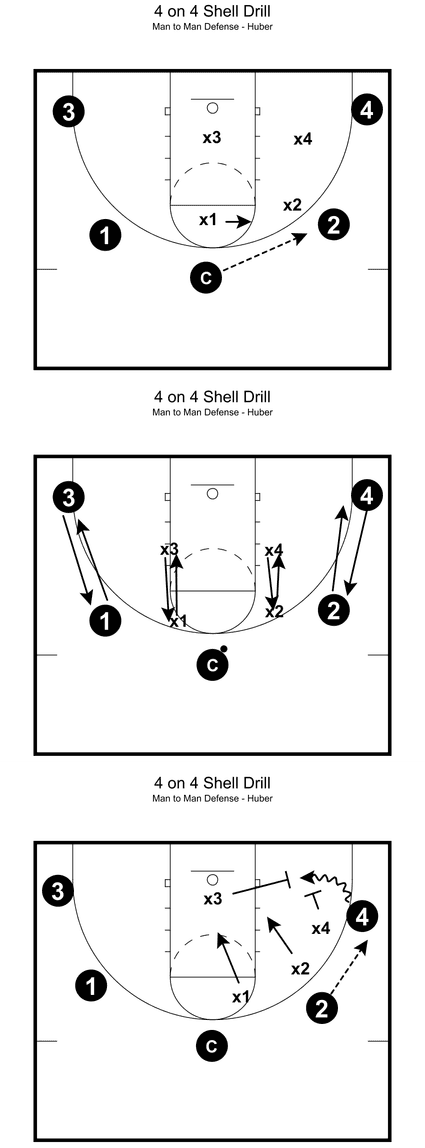
Diagram 2 - Instructions
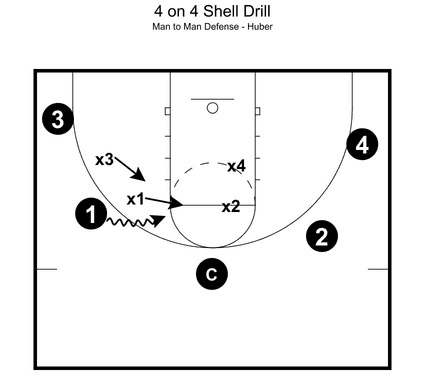
Diagram 3 - Instructions
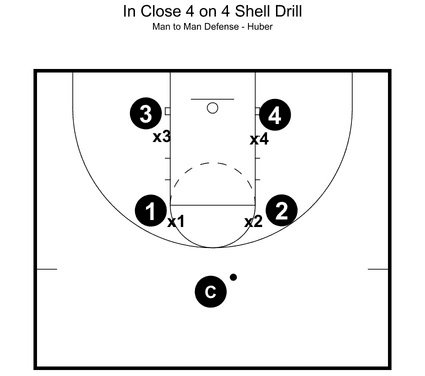
Diagram 4 - Instructions
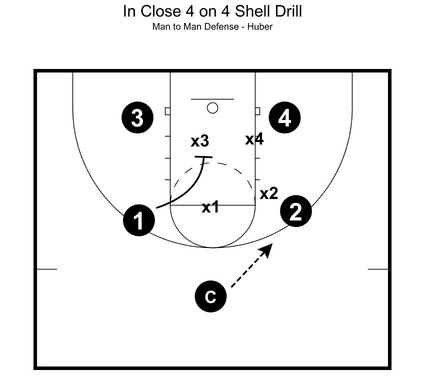
Diagram 5 - Points of Emphasis
Purpose
- The shell drill is a great tool for teaching your defense. From a big picture perspective, you can quickly teach your players exactly what your team defense should look like.
- You can practice all of your defensive concepts in a team situation. You work on ball defense, being in a great stance, closing out, jumping to the ball, sprinting areas, and other key defensive concepts.
- You can practice defending any situation. You can practice defending all types of cuts, screens, and offensive actions. You can practice defending basket cuts, backdoor cuts, flare cuts, down screens, ball screens, back screen, staggered screens, horns sets, Princeton sets, etc.
- It’s also great because it allows you to be efficient with your team. You can have four or five defenders practicing defense all at once.
- You can also use the shell drill to work on specific defensive techniques. That way, if you’re struggling with a particular offensive action, you can break it down and make sure your players understand how to defend in that situation. Also, you can get a bunch of reps in a short amount of time to solidify their learning.
- The following is a beginner progression for teaching the shell drill. You can also see progressions for teaching how to defend down screens and back screens.
Setup
- You position four or five offense players on the court.
- You position a defender guarding each offensive player.
Instructions
- Progression 1 – Positioning Whenyou instruct, “Pass.” Offense passes the ball. You look for correct help positioning, proper close outs, appropriate on-ball defense, and necessary effort.
- Progression 2 – Interchange This is the same as progression 1, except now you have the players interchange positions from corner to wing when you instruct, “Interchange.” This is a great way to get players defending more positions and situations.
- Progression 3 – Baseline Drive Now you instruct, “Pass. Skip. Beat Them. Pass Out.” “Pass” indicates that you pass to the person next to you.
- “Skip” indicates you pass to the player two people away from you.
- “Beat Them” means that you drive baseline to force help. At first, the on-ball defender will let the ball handler go to practice rotations.
(Diagram 1)
- “Pass Out or Kick Out” means that after the baseline drive, the ball handler turns and passes the ball back out to a perimeter player.
- Progression 4 – Live You take the defense through the same baseline drive routine as progression 3.
- You now instruct, “Live!” This means that the offense and defense play basketball.
- Rotate defense to offense after a predetermined number of “stops” by the defense.
- The drill can also progress to allowing the offense to rotate and have basket cutters.
- Progression 5 – Down Screens The drill is set up with 4 offensive (black) and 4 defensive players (numbers), with a coach up top with the ball.
- The coach will start the drill by passing to one of the players at the elbow.
- The helpside offensive players will set a predetermined screen.
- The defense will jump to the ball and work to defend the screen correctly.
(Diagram 2)
(Diagram 3)
(Diagram 4)
- Once screens are consistently being defended correctly, the drill can be moved to a “live” scenario.
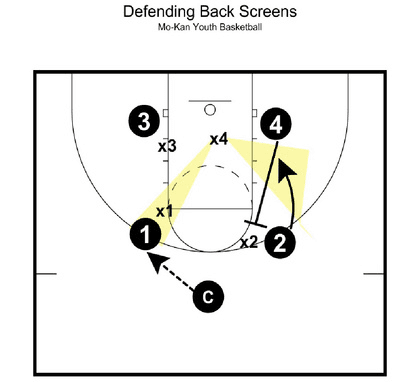
- Progression 6 – Back Screens The drill is set up with 4 offensive players on the outside and 4 defenders on the inside. Coach is up top with the ball.
- Coach starts the drill with a pass to the elbow.
- The offensive player on the weak side block will set a back screen for their teammate on the weak side elbow.
- Defender X4 will hang back and become “goalie” and defend the lob, seeing cutter and the ball (yellow areas).
- Once the player who was back screened gets through and recovers, the “goalie” can close out on their player.
Points of Emphasis
- Jump To The Ball – Make sure we are anticipating the pass and jumping with ball, not reacting to the pass being caught. Move with the ball like you have a magnet in your chest.
- No Layups – Seal the seams and force the ball outside the scoring area, the area that we consider our “house”.
- Don’t Hug Your Player – Don’t hug your player when they are going to set a screen. If you hug the player, play too closely, the screener might be able to set a “double” screen and screen you and a teammate at the same time. Stay up the line, on the line from the ball and give the player being screened enough room to get through.
- Ball Side Of Down Screen – Jim teaches the defenders to go “ball side” of the screen, so we are coming up the middle in a help position. In the bottom diagram, X3 would fight to get around the screen on the ball side where the offense, 1 in black, has received the ball.
(Diagram 5)
- No Lobs – Non Negotiable on Defense – We do not allow LOBS on back screens.
- Get Skinny On Screens – When your player calls out the screen, get “skinny”. Turn at an angle that makes you more difficult to screen and be ready to move. If you get caught “fat and flat” by that back screen, you are going to have a difficult time recovering and getting round the screen.
Coaching Tips
- Demand Great Effort – Be sure they sprint to areas and give maximum effort. Often players think they are giving maximum effort, but they are not. Immediately correct and rep out until the player does this correctly. Playing with great effort can help you overcome a lot of mistakes.
- Master The Basics / Don’t Rush – When it comes to youth and high school basketball, don’t worry about progressing until you master the basics of positioning, help defense, communication, and effort. If you do these things, it can counter many things that the offense throws at you.
Made by Breakthrough Basketball