137 drills match your filters

Team Play
5v3 + 2 Fast Break Drill
Video by BreakthroughBBall
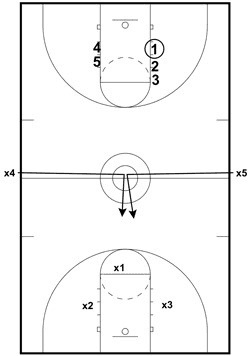
Drill begins with "Annie Over", Coach says "Go", we rebound, pitch out and we run our break. The two defenders at midcourt have to wait for the ball to cross half court, then sprint to the middle, touch hands and hustle down to join the defense. (Diagram 1) You can reset after every possession or run the drill continuously back and forth, with players running on and touching half court every time. Made by Breakthrough Basketball
Team Play
4v4 With Baseline Drivers
Video by BreakthroughBBall
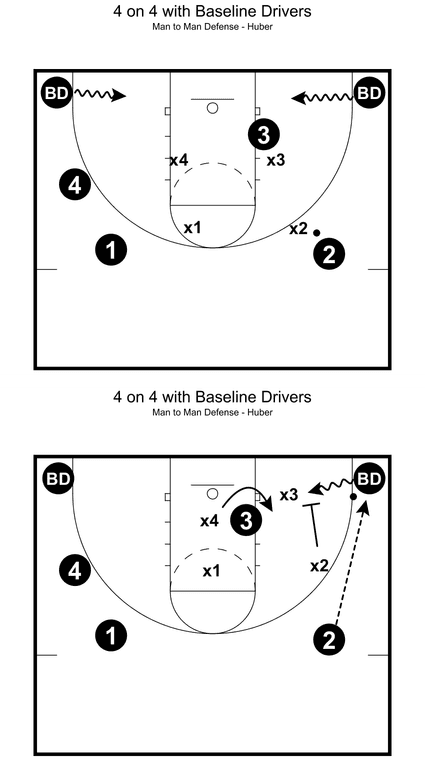
This drill is great for improving your team defense. Specifically, it improves your communication and your team’s ability to help and recover on dribble penetration. Your players have to give 100% effort and focus in order to succeed in the drill. This is a classic example of making practice more difficult than the games. If you can stop the opponent when you’re playing 6 on 4, you know that you can stop them playing 5 on 5. Since you succeed this during practice, you will have the confidence to lock down the opponents during games. There are four offensive players and four defensive players. Additionally, there are two designated baseline drivers (BD) who are positioned in the corners. They are not actively guarded. Baseline drivers can be coaches or players. (Diagram 1) You start the drill. The four offensive players try to score and the four defensive players try to stop them. The baseline driver can choose to drive or pass the ball immediately. If the baseline driver catches and holds the ball, no help is needed. If the baseline driver dribbles to the basket, the defense must stop the ball, communicate, and rotate. As your players begin to understand the rotations and are scrambling well, you can allow the offense to dribble penetrate, do interchanges, etc. This will make the drill much more challenging. See Your Player and the Ball – You must see your player and the ball at all times. If you take your eye off either one, it can result in an easy scoring opportunity for the offense. Help Early & Quick – You must sprint to spots and immediately move once you see the players dribble drive to the basket. If you wait for a split second, it’s too late. Teach When NOT To Help – If one of the guarded players attack the basket, teach your players when they should and should not help. Some coaches teach to help the player when they have a straight line advantage to the goal. If the defensive player is positioned between the player and the basket, don’t help. If the offensive player is not driving directly to the basket, don’t help. Mix Up Drive & Pass – Encourage the baseline driver to mix up between shooting and passing. This will make it more game-like and keep the defense alert and challenge them more. Made by Breakthrough Basketball
Team Play
5v2 Weak Side Help
Video by BreakthroughBBall
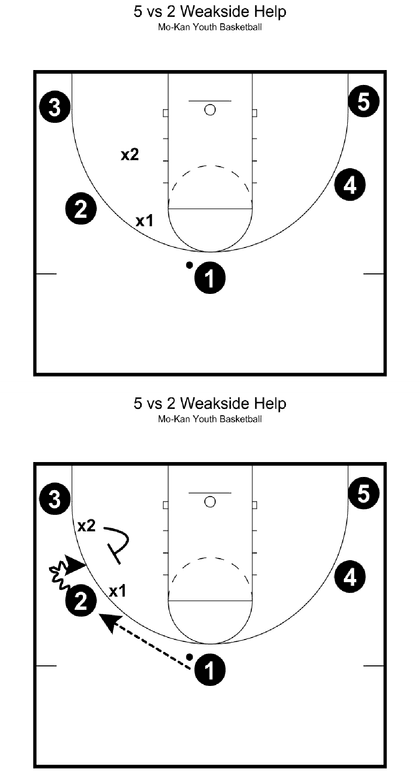
This defensive drill improves your defensive positioning, your ability to defend flash cutters, and communication on interchanges. It’s a great way to isolate two defensive players and take them through a variety of situations. Also, sometimes it can be difficult to see everything when you have four or five players on the floor. This is especially true for new coaches and even seasoned vets can’t see everything. This is agreat way to isolate your players, so you can see precisely what they’re doing and enforce good defensive habits. (Diagram 1) There are five offensive players on the perimeter. There are two defenders that are matched up man to man. X1 is guarding 2 and X2 is guarding 3. When the ball is passed to the wing, you are jumping to the ball. X1 is applying ball pressure and X2 is ready to help seal the seam on the dribble drive (bottom diagram). The ball can be skipped across, in which case the defenders would be jumping with the ball into a help position on the midline, head on swivel, looking for flash cutters. After the skip, the offensive players may flash cut the lane and look for the ball. The offensive players (2 and 3 in black) are allowed to interchange as well. Constant Communication – The two defenders should be in constant communication. That way, they know how to help, recover, and rotate properly. You don’t want two players guarding the ball. Sprint to Areas! Anything less than 100 percent is unacceptable. Get in the habit of going all out in sprinting to where you need to be. Move with the Pass, Not on the Catch – Be anticipatory in movement. Move with the ball as though a magnet was in your chest. Made by Breakthrough Basketball
Team Play
Marquette 3v3 Full Court
Video by BreakthroughBBall
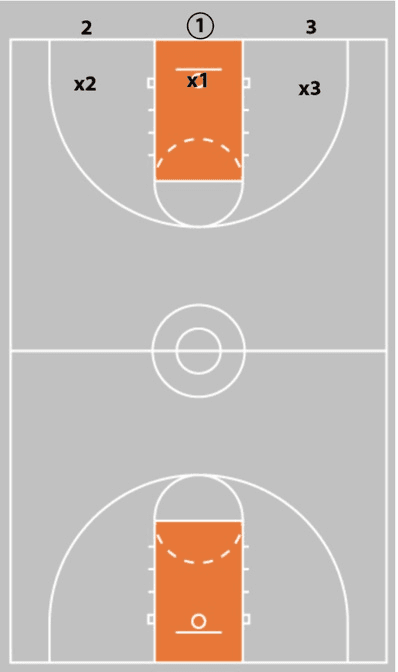
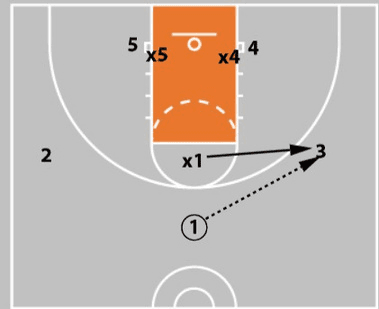
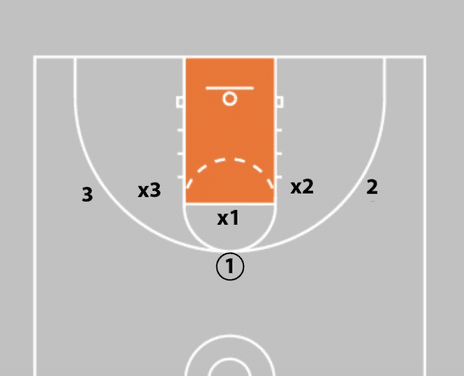
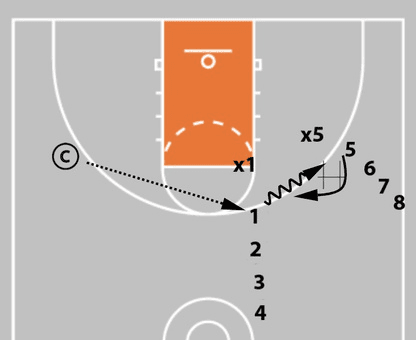
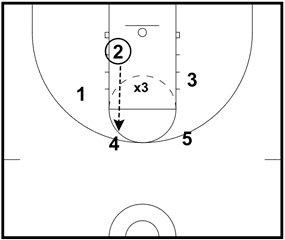
This drill is a great drill to emphasize no middle principles, angles, outer third mentality, and positioning. It focuses on on-ball defense, as well as one and two pass away positioning. When it becomes live 3-on-3, it reinforces low man/X man positioning, ball-you-man, and hitting and getting. 3 offensive players line up across the baseline. 3 defenders match up. (Diagram 1) The middle offensive player (1) starts with the ball. If the ball starts in the middle thirds, the defenders goal is to force the ball handler to the out thirds, preferably forcing them to dribble with their weaker hand. Player one has two dribbles to punch the gap between two defenders. Defender three must provide help defense and then quickly recover to defend. (Diagram 2) Because Defender 2 is two passes away, they must drop back so he can always be in a ball-you-man position. When Player 3 passes the ball back to Player 1, the defenders must rotate back to the correct position. This occurs throughout the drill. Once the ball crosses half court, it’s live 3v3. When a defender is two passes away, the defender must be ahead of the ball and be able to see the ball and man. Ball pressure is a must. Playing with only three defenders full court makes this a challenging drill for the defense. (Diagram 3) We want our defense to move as the ball moves. Made by Breakthrough Basketball
Team Play
3 v 3 One Side Of The Court
Video by BreakthroughBBall
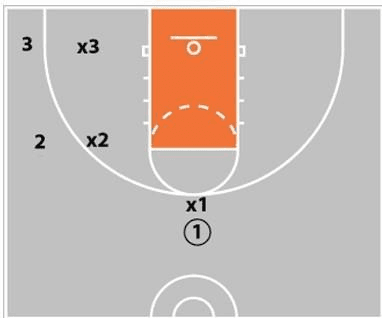
Teaching spacing is very challenging. This is true for players of all ages, but especially young players. One limitation of 3v3 drills is that players have way more space than they do in 5v5. This can cause struggles when players go back to playing 5v5. This drill teaches players to operate within a condensed space, making it more game-like. Position 3 offensive players on 1 side of the court. They are guarded by 3 defenders. (Diagram 1) 1 starts by passing to 2. (Diagram 2) The defense cannot steal this pass 1 cuts to the basket. 2 looks to pass to 1 for a layup. If 1 isn’t open, 2 can dribble to the top. This allows 3 to lift and 1 to replace to the corner. Play continues from there You can make the playing space bigger to help the defense or smaller to make it more challenging. You can have players do other actions besides cutting (such as screening). Players quickly learn they can’t stand. (Diagram 3) (Diagram 4) Consider also implementing a dribble limit (2 dribbles per touch). Made by Breakthrough Basketball
Team Play
Ball Screen Defense Drill
Video by BreakthroughBBall
The drill starts with 5 offensive players and 3 defensive players. The offensive players are positioned on the blocks and wings. The defensive players are positioned on the blocks and at the top of the key. Be sure to rotate players through multiple spots. The drill starts with the 1 passing the ball to the wing. X1 sprints to cover the wing. 1 is then out of the drill. (Diagram 1) On all 3 reps, the offensive wings should allow X1 to get to them before dribbling. If they go before then, the drill won’t simulate a realistic ball screen situation. On the first rep, the big is in a drop coverage. X1 forces 3 to use the screen (does not allow them to reject the screen). X1 then chases over the top of the screen. X4 stays back to protect against the roll. This coverage protects the paint. It is designed to allow contested mid range pullup jumpers, a low percentage shot. After coming off the screen, 3 passes to 2 on the opposite wing. X4, as well as 3 and 4, return to their original positions. (Diagram 2) (Diagram 3) X1 sprints through to cover 2, who holds the ball until X1 arrives. On the second rep, the defense executes a flat hedge ball screen coverage. In this coverage, x5 moves laterally with the dribbler. As with the first rep, X1 goes over the screen. X5 continues laterally until X1 gets back in front. X1 should communicate to X5 when he can recover to their player. It’s important that X5 have high hands to deter a pass to 5 rolling. (Diagram 4) (Diagram 5) X5 recovers to 5 with high hands. 2 passes the ball to 3. X1 sprints to cover 3. For the final rep, the defense traps the ball screen. As 3 comes off the screen, X4 and X1 trap. X1 must get over the screen. X4 must get perpendicular to half court to cut off 3. X5 must move to the ball side as the trap is being set to anticipate the next pass. (Diagram 6) (Diagram 7) X1 and X4 trap 3. X5 fully rotates to deny the pass to 4. Make sure the defense dictates where the ball goes. The players guarding the dribbler MUST make them use the screen. They cannot allow the screen to be rejected by the ball handler. Stress proper defensive footwork. For all 3 reps, the on ball defender goes over the screen. Players must “get skinny” to present a smaller target for the screener. They must also get their foot over the screen and then sprint to get back in front. For the bigs, their footwork is equally important. On the flat hedge, they must be able to move laterally with the dribbler and then backpedal or sprint back to the roll man. On the trap, they must get perpendicular to half court. In the trap, players feet should be touching so they don’t get split. Communication from the big is essential. The defender guarding the screener must tell the guard what coverage they are in. Coach Schultz uses colors. Whatever terminology you use for ball screen coverage, your big must communicate this. Feel free to mix whatever ball screen coverages you use into the drill. Have the offensive guards work on their ball screen setups in this drill to develop that habit. Consider going live at any point of the drill. You could say the 3rd rep is live or call out ‘live’ at any point. Play would then be 3v3 with the opposite wing out of the play. Made by Breakthrough Basketball
Team Play
Disadvantage Drill
Video by BreakthroughBBall
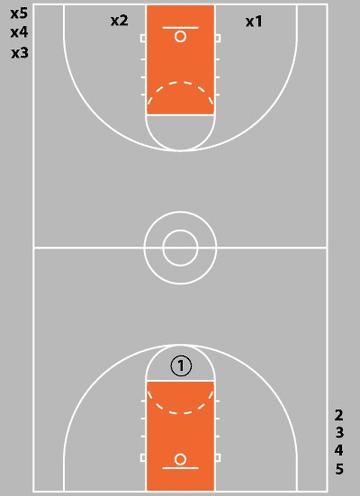
Transition offense and defense are best worked on in a variety of ways. Throughout a game, your team will see various situations - 2v1, 3v2, all the way to 5v4. This drill incorporates all of those situations and more, allowing you to work on general transition principles while also coaching the specifics of each situation. Split your team in 2. 1 team starts with one player out (1) who has a ball. The other team has 2 defenders waiting at the opposite end. (Diagram 1) Other players wait on the sideline/baseline at their end. Player 1 speed dribbles down the court and shoots a free throw line jumpshot. After that possession ends, x1 and x2 are on offense going back (Diagram 2) (Diagram 3) 1 is on defense After that possession ends, x1 and x2 go back on defense 1, 2, and 3 are on offense After that possession ends, 1, 2, and 3 go back on defense (Diagram 4) (Diagram 5) x1-x4 are on offense After that possession ends, 1-5 are on offense x1-x4 get back on defense After that possession ends, x1-x5 go on offense 1-5 are on defense (Diagram 6) (Diagram 7) It is 5 on 5 from this point on Defensive goal is to force the offense into a jump shot PG should take one dribble toward the side they are passing to in order to create abetter passing angle. Bounce passes should be encouraged as they are less likely to be stolen Only inbound the ball on this drill when they are at 5v5. Once the ball crosses half court, the offense is only allowed as many passes as there are defenders. In other words, 1 pass in 2v1, 2 passes in 3v2, etc. This simulates the fact that advantages disappear quickly in 5v5. The offense is allowed as many shot attempts as there are offensive players. This prevents the disadvantaged defense from being on defense for a long time because they can’t get a rebound. For example, in 2v1 the offense gets 2 shots, 4v3 they get 4 shots, etc. If the offense misses the last shot, they must transition back on defense. The defense should transition to appropriate formations when disadvantaged 2 defenders - line 3 defenders - triangle 4 defenders - box When it gets to 5v5, the defense must talk and match up. Made by Breakthrough Basketball
Team Play
Charge To Scramble
Video by BreakthroughBBall
Getting players to take charges can be difficult. Many players fear getting hurt. This drill helps teach players how to properly take a charge. It combines that with forcing defensive rotation, making your defense scramble to get a shot. At the same time, your offense works on maintaining their advantage. Position 3 offensive players on the wings and at the top of the key. A defender matches up with each offensive player. The defenders start in man to man with defenders being 1 pass away and in the gap to take away the drive. (Diagram 1) Defenders should have a no middle stance. Players start playing 3 on 3. Player 1 can throw it to either Player 2 or 3. The defense works on rotating to the correct position and staying low. (Diagram 2) (Diagram 3) The offense swings the ball around the perimeter to the other side. Player 3 drives to the baseline and the opposite defender tries to draw the charge. That player falls down selling the charge. At this point, the offensive player kicks the ballout and live play begins. Use both ends when possible to double the amount of reps. Ifyou want players to take charges in games, you need to practice this skill. The defender should take the charge outside of the lane. The defenders need to guard the ball and the basket at all time Points of Emphasis Stay low and in stance Communicate Iron out the next threat (Diagram 4) The offense should look to keep the ball moving and not let the defense recover. Made by Breakthrough Basketball
Team Play
Press Breaker Drill
Video by BreakthroughBBall
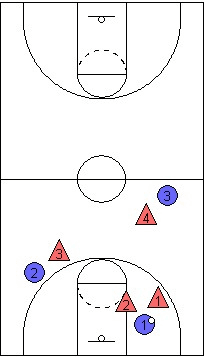
Instructions: 1. You can use different variations. Hereare a few examples: -3 on 2 -4 on 3 -7 on 5 In the diagram to the right, we use 4 defenders and 3 offensive players. 2. Have the offense take the ball out of bounds. From there, the offense tries to break the press and score. If limited on time, we will have the offense start the drill over as soon as they pass half-court. You can vary the press between full-court denial, full-court, or 3/4 court (or anything else you think of) to adjust to the types of pressure you will face. This is a very simple, yet extremely effective concept. Sometimes, when you face pressing teams, it can feel like 7 or 8 defenders are out there on the court. Why not practice like that? If your offense can successfully break pressure against 7 or 8 defenders, they should be able to break most pressure. Made by Breakthrough Basketball
Shooting
2v1 Shooting
Video by BreakthroughBBall
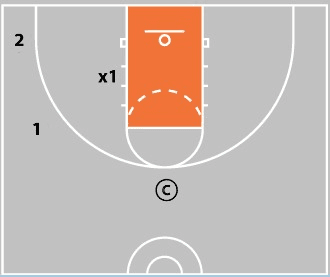
2v1 Shooting is a great drill to work on the shot or pass decision. It is a way for players to get game shots in a fun and competitive manner. It’s also a great defensive drill. It simulates a situation when the defense is at a disadvantage and one player has to guard two until their teammates arrive. Place 2 offensive players anywhere on the court, one pass away from each other. 1 defensive player starts close to the basket. The coach has a ball (Diagram 1) 1 and 2 are on offense x1 is on defense Coach passes to either 1 or 2 Coach passes to 1 in this case x1 closes out on the ball 1 can shoot or pass. The offense may not dribble or move. 1 passes to 2. The offense has a 1 pass limit so 2 has to shoot. 2 takes the shot (Diagram 2) (Diagram 3) x1 contests the shot You can predetermine what the D must do or have them do random actions. Be sure to emphasize passes being on time and on target. Offensive players should look at the rim before making the ‘one more’ pass. Players should think shot first. If the defender is more than an arm’s length away, the offense should shoot. If the defense is closer, that cues a pass. You can progress the drill and have the offensive player who receives the pass from the coach drive the ball. This allows you to work on your penetration reaction. If you like the side step 3, you can allow players to take one side dribble before shooting as shown in the video. Use different spots on the floor. If you have more coaches than groups, have the defense start with the ball and pass to an offensive player to begin the drill. Make the drill competitive. If the defense forces a miss or gets a deflection, they replace the player who shot (or threw the bad pass). If the offense makes the shot, the defender remains on defense. The defender’s goal is twofold. First, they want to make the offensive indecisive. Players should stunt at the player who receives the pass and also try to get a hand in the passing lane to deter straight line passes. The second defensive goal is to make the worst shooter take the shot. Defenders should know the offensive players and try to make the weaker shooter end up shooting a contested jump shot. Made by Breakthrough Basketball
Team Play
2v2 Zoom
Video by BreakthroughBBall
Players need reps to get better at your primary offensive actions. This drill teaches your players how to utilize the zoom action no matter defensive coverage your opponent employs. Every player get a lot of repetitions, building confidence in their ability to attack every defense. Position an offensive player in the slot and on the wing. Defenders match up. The coach starts with the ball on the opposite wing. The coach enters the ball to the player in the slot. (Diagram 1) The offense then flows into a zoom action. Defense can fight over or under. If the defense goes over, 1 should make the handoff and 5 should attack the paint If the defender goes under, the Trigger should forward pivot and rescreen. (Diagram 2) (Diagram 3) The Trigger must maintain good spacing on the roll. The defense has to switch the zoom. Could use a pitch behind for a three point shot. Trigger could keep the dribble alive and attack the basket v a mismatch. One of the most common mistakes is picking the ball up early after a switch. (Diagram 4) (Diagram 5) The roller (1) should seal the switching defender (5x) on their back. Now the defense will trap (or blitz) every zoom. The player that would normally make the handoff should look to fake the handoff and attack the rim. This is called a keep. (Diagram 6) (Diagram 7) If the Trigger does pick it up and hands it off, the Trigger should do a short roll looking for a window to receive the pass. 5 should look to hit 1 with a jump pass or pocket pass. 1 would then look to attack 4v3. Both players in the zoom should scan to the defense as they approach the handoff to try and anticipate what the defense is doing. You can tell the defense what they have to do or allow them to choose. The deeper the Trigger can get, the farther his man has to go to switch A good setup is important. Player 5 should look to go backdoor is x5 overplays. Stress that the pitch should be a soft toss to the torso. (Diagram 8) You can do the same drill with other on-ball actions, such as ball screens. Made by Breakthrough Basketball
Conditioning
1 on 1 Closeout
Video by BreakthroughBBall
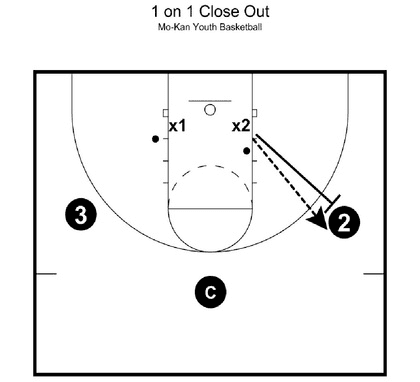
If you don’t have great defensive closeouts, it doesn’t matter how great your help defense is when you are at a constant disadvantage, the offense is going to score a lot. And think about this, you can have anywhere between 100 to 250 close outs per game. Multiply that over the course of a season, you might have 2,000 to 10,000 close outs per season!! Poor closeouts can destroy your defense which will lead to the offense scoring more points against you. In order to have a great defense night in and night out, you must be able to defend the basketball in a one on one setting. This is a fast-paced drill to practice in order to get better at closing out, contest shots, and prevent dribble penetration. It forces defenders to learn how to defend in a game-like environment. There is nothing better than improving on ball defense by putting the defensive player out on an island and forcing the defender to stop the player one on one. Defense, X1 and X2 start under the basket. Each player has a basketball. The two offensive players are positioned on the wings. X2 starts the drill with a pass to 2 on the wing. Defender X2 follows the pass with a hard close out. The Defender’s job is keep the ball out of the house (paint area) and force a contested jump shot, then block out and hunt the rebound. Progression 1: The offense is not allowed to go “live” until the defender closes out and gives them a “touch” of the hand. After one repetition, you can go to the next progression. Progression 2: The offense goes “live” immediately on the catch. (Diagram 1) Sprint To Eliminate Offensive Advantage – Defensive players should sprint on the close outs. The quicker you can contest a shot and immediately get into a balanced position to eliminate dribble penetration, the less of an advantage the offense will have. Hands Up – Depending on your preference, either have one hand or two hands up to contest the shot and immediate entry passes from the offensive player. Position Appropriately – Whether you believe in getting the defender’s butt to the basket or forcing the offensive player in a particular direction, be sure to position yourself appropriately. Bad positioning will create easy driving opportunities for the offense. Practice Good Offensive Habits – Make sure we emphasis the little things in every drill. Is the offense coming forward to catch the pass? Or are we being lazy, standing still waiting on the pass? Just because the focus of a drill is defensive, don’t let little things slide with the offensive players. If you let little things slide in practice, you’ll end up getting beat by little things in games. Loser Stays On Defense – If the offense scores, the defender must stay on defense until they get a stop. You can rotate the offensive player each repetition. Add Passer – So the defender doesn’t know when the pass is going to occur, you can have the coach, manager, or other players pass. This will improve anticipatory skills and reaction speed for the defender as it emulates what will happen during a game. Vary The Passing Position – You can also pass from different positions on the floor to close out from different angles and positions like you would during a game. You can also have coaches, managers, or other players act as passers. Time Clock / Limited Dribbling – You can also have dribble limits and time clocks, so the offense also has to practice good offensive habits. Alternate Sides – Go side to side for efficiency. When one pair is running live, another pair should be ready to go on the other side. Make Drills Competitive – Make the drills competitive by having players keep score. Create accountability. Made by Breakthrough Basketball
Footwork
Curl Cut
Video by BreakthroughBBall
1 starts the drill by passing to 2 3 curls off 1’s screen to receive a pass from coach on the left wing 3 should curl when the defender is trailing the play 1 cuts to the top of the key to receive a pass from 2 for the shot 1 moves to the end of 3’s line 2 moves to the end of 1’s line 3 moves to the end of 2’s line Follow the pass for a step before setting the screen in order to create a better screening angle (Diagram 1) (Diagram 2) Take a step towards the baseline to give the offense more depth and a better screening angle Made by Breakthrough Basketball
Ball Handling
1v2 Zone Press Drill
Video by BreakthroughBBall
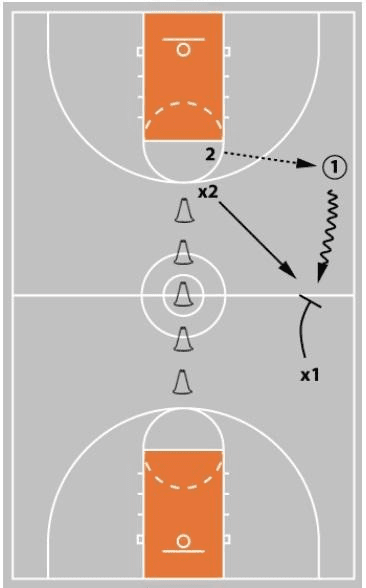
Handling pressure is a must have skill at all levels. This drill is a great way to teach players how to value the ball when they are being trapped. It also allows your defenders to work on proper trapping angles and technique. Player 2 has a basketball and is in the free throw line area. Player 1 is on the sideline, level with player 2 X2 guards 2. X1 waits back at the opposite volleyball line. Cones are placed down the center of the court to limit the area 1 has to use. 2 passes to 1. 2 is then out of the play. 1 catches and attacks with speed. X2 sprints towards half court to attempt to trap play 1 with x1. Play continues until the offensive player gets to the opposite volleyball line or the defense forces a turnover. (Diagram 1) Stress to the defenders the importance of good trapping technique. They should look to take good angles and then lock feet when they trap 1. 1 should look to attack with speed. The slower 1 goes, the more time for the defense to set a trap. 1 should attack and look to split or beat the trap making one hard move. Make the drill easier for the offense by moving the dribble ahead of the passer by a couple steps. Make it harder by moving them behind the passer. You can adjust the difficulty of the drill by where you place the cones. The more space you give the offense, the more it gives them an advantage. Instead of having play stop if the offense gets to the volleyball line, consider having the offense try to score. Remind your players that in a game, they should look to pass when the other team attempts to trap. This drill is meant to challenge their ball handling more so than replicate what they would do in a game. Sometimes the defense won’t be able to trap. In those situations, encourage them to look to back tap up on the ball from behind. Made by Breakthrough Basketball
Passing
Bull In The Ring
Video by BreakthroughBBall
Four to five players form a circle around a defender which is the bull in the ring. Offensive players cannot pass the ball to the person next to them. (Diagram 1) When the ball is tipped, the passer turns into the bull in the ring. Made by Breakthrough Basketball
Conditioning
2 v 2 Shell
Video by BreakthroughBBall
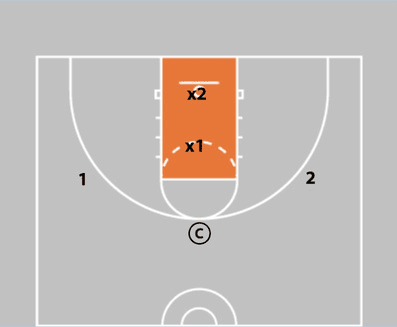
We break this down to get reps with live movement. We are focusing on our long closeouts. We want them to think about their angles and their approach. We want our players “doing the work before the work”. This drill is a build up from 2-on-2 to 3-on-3. We do this drill with less bodies because it makes the closeouts longer and more challenging. It is more challenging to defend with fewer players which makes it easier when actually playing 5-on-5. This is a progression to our 5-on-5 live drill with a scoring system. Our focus is for our players to be in a ball-you-man position. The ball and the angles of the closeouts are constantly changing. The players are always in a long closeout situation. Offensive players start elbow extended. Defensive players start on the help line. The coach initiates the drill by tell the defenders to chop it up. (Diagram 1) The coach yells, “Stance”, and he defenders closeout on their man. The coach begins passing along the perimeter. The defenders position themselves to be on the ball and help defenders. They rush to close out. Off ball defenders must see ball and man at all times. It is imperative that players rotate from X man to low man depending on the location of the ball. The drill lasts for twenty seconds. The defense becomes the offense, and the offensive players leave the court. A new set of defenders enters the drill. (Diagram 2) 1. Players being able to self-correct is a huge part of a learning process. 2. If a you nger player is unaware of a mistake, you also hope your leaders will help and hold those you nger players accountable 3. Playing 2-on-2 lets coaches easily evaluate strengths and weaknesses of players. Made by Breakthrough Basketball
Shooting · Passing
Post Entry Team
Video by BreakthroughBBall
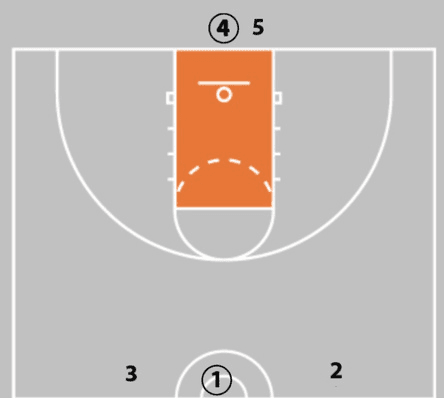
Shooting In this third variation of Primary Break, we will execute a Laker cut to the basket. The initial ball handler will drift to the corner as the safety valve. 1. The drill begins the same as the previous variations. (Diagram 1) (Diagram 2) 2. Player 1 passes ahead to Player 2. 3. Player 3 runs and stops a little higher on the block. 1. Player 2 enters the ball to the post who is set up above the block. 2. Player 2, instead of setting a screen, will execute a Laker cut and receivea pass from Player 3. 3. Player 1 will drift to the corner and receive a pass from Player 4 for a 3-point shot attempt. (Diagram 3) (Diagram 4) 1. This is another option for our players. Once the defense stops one action, we have alternatives for each set. 2. The offense can backdoor or go over the top of the screen depending on the defender’s position. 3. In these drills, the players are getting a lot of reps in a pressure situation which simulates game-like pressure. 4. The players are getting game shots at game speed. 5. They are building their IQ by understanding spacing and concepts 6. These actions will become reads by players during the game. Made by Breakthrough Basketball
Finishing · Footwork
Euro Step Drill
Video by BreakthroughBBall
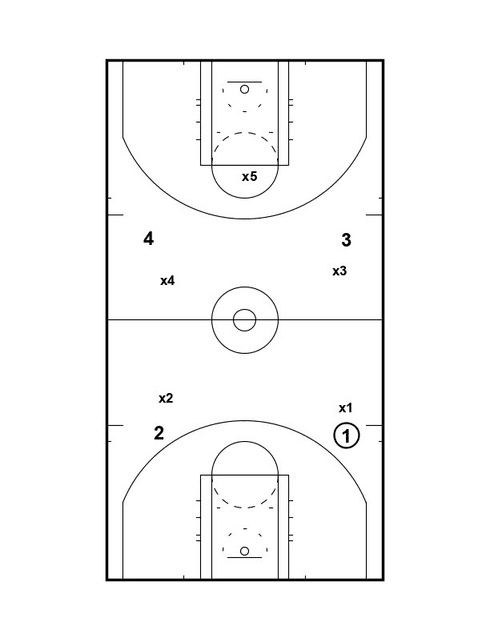
Some players can learn this move just by reading it and others need to watch it to properly learn it. A complete video description of this finishing move can be found here: Euro Step/Side Step Drill Progression 1: Two Steps - No Dribble You simply take the jab step and the side step. As you get the footwork down, then you want to focus on long, explosive steps. In a way, this is a progression within a progression. Note, this is a travel. However, it's used just as a progression to help you learn the footwork. Progression 2: Euro Step - Add Dribble Now, you practice adding the dribble to the Euro Step move. You start a step or two inside the 3-point line depending on the age of the player. Progression 3: Euro Step from 3 Point Line Now, you have the players back up and use the move from the 3-point line. Some Additional Tips: Add this little progression - After progression 1 and before progression 2, you can also squeeze in a progression where the players only take two steps like in a progression 1. However, you add the dribble. Practice from all angles and distances - Once you can execute the footwork, practice this move from different angles and distances all over the half court. Since the amount of dribbles and distance that you jump from can change each time during the game, it's very important to do this. If the defender recovers or the help defense steps up further, you can use a change of direction move. This will use the defender's momentum against them and give you a lane to attack the basket. Made by Breakthrough Basketball
Reaction
4v4 Box Middle Drill
Video by BreakthroughBBall
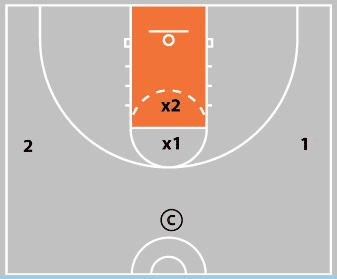
A great drill to work on your jumps when the ball is dribbled to the middle. After the jump you get to work on your rotations in the press. 4 offensive players line up in a box formation. 4 defenders matchup with a 5th defender back at the rim. The 5th defender is there to steal any deep passes. The drill begins with player 1 attacking the middle of the floor. This cues X2 & X1 to execute a run and jump. (Diagram 1) (Diagram 2) X3, X4, & X5 all move with the ball. After the run and jump, X2 will be matched up with 1 and X1 will be guarding 2. Play is then live. The defense should look for other opportunities to jump and trap throughout the possession. (Diagram 3) Tip: Remind players to jump on the line of the next pass. That makes the ball handler throw the ball over the player who is jumping the ball. This increases the likelihood of a deflection. It also forces a slower pass, allowing your defenders more time to rotate. Made by Breakthrough Basketball
Footwork
2 Minute Closeouts
Video by BreakthroughBBall
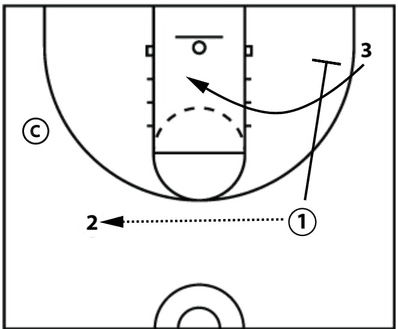
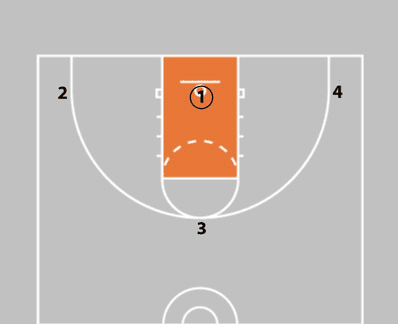
Two minute closeouts is a great daily drill to build good defensive habits. Players get multiple reps of closeouts, as well as jumping to the ball. It’s a good warmup drill to ingrain proper defensive techniques. Coach starts out with the ball at the top of the key 2 players (or other coaches) are on each wing A line of defensive players is under the rim. The first 2 players are on the midline (Diagram 1) (Diagram 2) Coach passes to 1 x1 closes out to 1 1 passes to 2 x2 closes out to the ball x1 sprints middle x1 steps off (Diagram 3) (Diagram 4) x3 take’s x1 spot in the middle. X3 should run into the correct help position spot One progression of the drill is to make it 4v4. This allows you to include more players and guard different spots on the floor. Now the drill is 4 on 4 Coach starts with the ball Players 1-4 are on offense Players x1-x4 are on defense Coach passes to 1 x1 closes out on the ball (Diagram 5) (Diagram 6) x2 fills the gap x3 and x4 jump into the midline. They should communicate their positioning to the x1 & x2. 1 passes to 3 x3 and x4 shift to the left side. The defender must move on the flight of the pass. (Diagram 7) (Diagram 8) x1 and x2 shift middle. x1 & x2 need to sprint to their help spots. If they slide, they will be too slow. x1 and x2 step off 5 and x5 step on The drill is continuous Place an emphasis on proper footwork and closing out hard. Individual coaches have varying preferences on technique. Whatever yours is, enforce it. The drill also works on defensive positioning one pass away from the ball. Player must jump to the ball on every pass. Onthe catch the offense should fake and/or jab at the defender. They should be inan athletic position. Offensive players shouldn’t go through the motions. Take away shot first with a high hand and then bring hands down to the side when taking away the drive When the ball is brought low by the offensive player, the defense needs to give a little space in case there is a drive (Diagram 9) Depending on your numbers, use both ends of the court to get more reps Made by Breakthrough Basketball
Conditioning
B. U. Closeout
Video by BreakthroughBBall
This whole goal of this drill is to put players on an island against three different offensive players. We make it competitive by having a scoring system. Players who lose have some type of jumping or running drill afterwards. At the end of the day, the drill is about reinforcing our defensive philosophy: forcing outer thirds correct angles on closeouts hit and get low and X man rotations The drill begins with the defender holding the ball underneath the basket. (Diagram 1) There are three offensive players on the court, and he has to defend against them all one at a time. Player 1 now plays defense against Player 4. Player 4 is only allowed two dribbles in order to score. When Player 4 shoots, Player 1 must hit and get the ball. If the offensive player gets the rebound, they reset and play again. Now Player 1 passes the ball to Player 3 and plays defense against him. The same dribble limits and rebounding rules apply Now Player 1 passes the ball to Player 2 and plays defense against him. Player 2 is only allowed two dribbles in order to score. (Diagram 2) (Diagram 3) (Diagram 4) When Player 2 shoots, Player 1 must hit and get the ball. If the defensive player stops two of the three offensive players from scoring, he leaves his defensive position in the hole and the offensive player on the left baseline becomes the defender in the hole. A player in lines comes in to play offensive on the right baseline, and the other two offensive players rotate around the perimeter. If the defensive player does not get two stops, he remains playing defense in the hole. 1 point for offensive score 2 points if you get to leave the hole on defense 2 points for any charges taken 1. It is important for players to understand that sometimes they do things perfectly and opponents hit tough shots. 2. Coaches need to continually emphasize the correct angles and closeouts. 3. If there is a catch and shoot, we want to be the second jumper. We remain down with our hand up on our closeouts. This prevents fouling and possible pump fakes and blow bys. 4. Defense is about multiple efforts. A player's first effort is the close out. The second effort is using an angle to stop the drive. The second effort is the most important one. 5. Players must be careful not to over closeout. This allows for quick penetration. Defenders need to allow for some space on their closeout. 6. Defenders must KYP (know your personnel). If an offensive player is quicker, then allow for more space. If you have a size advantage, you can close out a step back. 7. Our goal is to only allow contested 2-point shot attempts. We are not giving clean threes off of drive and kicks. We are running guys off of the line. We are becoming second jumpers on contested two’s. Made by Breakthrough Basketball
Conditioning
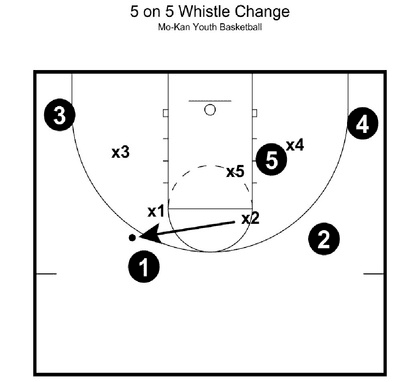
5v4 Whistle Change
Video by BreakthroughBBall
This drill works on your defenders’ ability to scramble and pick up a different player when a game situation forces them to do so. This often happens in transition and rotating out of help defense. Communication is a must in this drill and your players will be forced to improve. (Diagram 1) You start with five offensive players and five defensive players. They are matched up five on five. You start playing five on five live. On the whistle, the offense will set the ball down on the ground. Someone on defense (anyone but the player who was guarding the ball), has to pick the ball up. X2 is picking it up in the diagram. When the X2 picks the ball up X2’s team is on offense. The team that sets the ball down (in black) must scramble to guard someone. They cannot pick up the player that was guarding them. Example, 1 in black could not pick up X1. Communicate! – Players must communicate in this drill. If they don’t, they will fail. Forcing players to talk and think on their feet as they scramble is making practice harder than what they will likely face in a game situation. Anytime you can do that in a drill, your team stands to benefit in the game. Stop the Ball – Even though players are matching up in the drill, they must be aware of the ball handler. The ultimate goal is to stop the offense from scoring, so help defense must be alert and stop the ball when necessary. Full Court – You can also play the game full court as a variation. You don’t even have to start in ahalf court setting. Make sure to keep the team’s baskets the same, though. Variety – Make sure to vary who has possession of the ball and the location of the ball when blowing the whistle. Keep Coaching Defense – Keep coaching proper defensive fundamentals throughout the drill. Make sure that they close out properly, maintaining good position, rotate on help, defend screens properly, etc. Made by Breakthrough Basketball
Passing
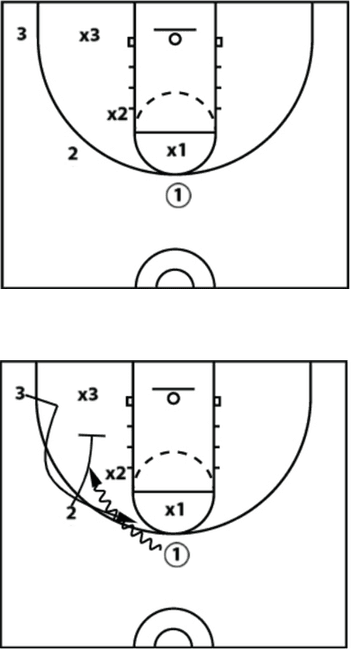
Zoom Reads Drill
Video by BreakthroughBBall
Once players are able to make reads in the 1 on 1 and 2 on 2 drills then it is time to introduce the full zoom action in 3 on 3 small sided games. This drill incorporates all three spots and works on all of the reads that will be happening within this action. This drill can be focused on a specific action, players, or read and should be a staple of any practice plan for teams implementing zoom actions in their offense. Player 1 starts at the top of the key with a basketball and a defender Player 2 starts on the wing with a defender Player 3 starts in the corner with a defender (Diagram 1) The drill begins with player 2 setting a screener for player 3 while at the same time player 1 dribbles directly at player 2. At this point the drill is live 3 on 3 with the opposite lane line serving as an out of bounds. Reads/reactions to the other players Getting downhill into the paint on the dribble handoffs. Quick/Hard cuts while reading the zoom action Start with the ball on the opposite wing: Have a coach or manager start with the basketball and the drill begins when the ball is passed to the player at the top of the key. Also, the defenders should be in their help positions while the ball is on the opposite wing. This allows for a more accurate timing of when the ball is swung directly into a zoom action. Predetermine Reads: When beginning to teach the zoom action, it may be beneficial to give the cutter a predetermined action (back cut, take dribble handoff, or don’t take dribble handoff) in order to focus on exactly what the read will look like in live 5 on 5 action. Specific Player Must Get a Shot: Challenge your players with giving them a predetermined player who must get the shot. This will help them focus on which read will be needed in the zoom action. This shouldn’t be done all of the time but a good changeup to help get more out of the drill. Mistakes Are Going to Happen: Remind players that the read they make won’t be the best one every time. A bad read that is done quickly and decisively is always better than in decision. Teach by Using the Defense: Teach the reads within the zoom by using the defensive players. For example, talk about the defensive player who went under the screen and that is why the offensive team got an open look. This will help the players understand the “why” behind the reads of the zoom action. Made by Breakthrough Basketball
Footwork
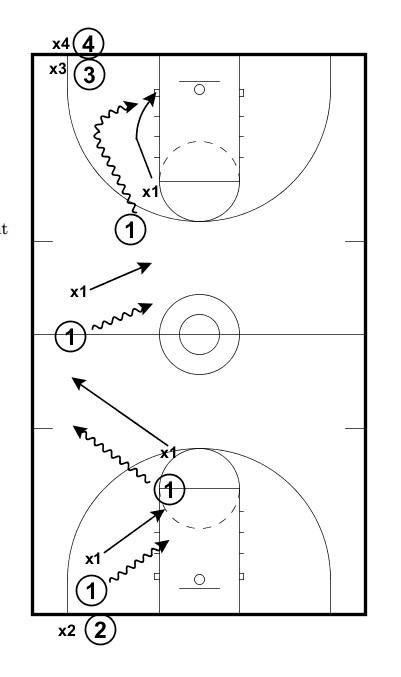
Full Court 1v1 With Turns
Video by BreakthroughBBall
Good zone teams can guard the ball 1v1. Even though they don’t play man to man, they take pride in being able to guard the basketball. Offensive and defensive players start on the baseline. The offense has a ball The offensive player tries to beat the defender down the floor. The defender tries to turn the ball as many times as possible. (Diagram 1) Once the ball crosses half court, it’s live 1v1. Stress proper defensive footwork. Players will need to use a combination of sliding and sprinting to contain the dribbler. Limit the space the offensive player can use. You can give them half the floor. To make it harder on the defense, make the space wider. Play through the rebound to develop good rebounding habits. You can switch offense and defense every time or have a player stay on defense until they get a stop. Made by Breakthrough Basketball