 Curated by HoopDrills
OffenseTeam DrillTeen (12-17)Adult (18+)All Levels
Shooting We want our players to understand they can reject a dribble handoff at any time. Just like you can reject a ball screen, you can reject a dribble handoff. 1. Sometimes the defender knows the dribble handoff is coming. 2. If the defender is overplaying the dribble handoff, Player 1 or Player 2 signals a backdoor cut. 3. Before receiving the dribble handoff, Player two performs a backdoor cut and receives the pass from Player one for a potential layup.
Diagrams
Diagram 1 - Coaching Tips
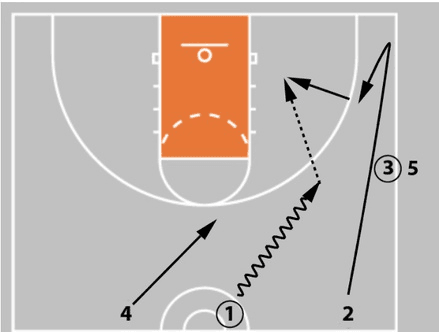
Diagram 2 - Coaching Tips
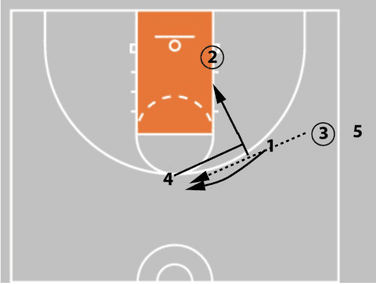
Coaching Tips
- 1. The wing, Player 2, does not have to even run up for the dribble handoff. A backdoor cut can immediately be used with a jab step.
- 2. Don’t make the dribbler guess what you’re going to do- develop a signal for accepting or rejecting the DHO (dribble handoff).
- 3. It can be as simple as putting up an open hand. It just needs to be visible to the ball handler.
(Diagram 1)
- 4. The signal for rejecting it could be a closed fist.
- 4. While Player 2 is attacking the basket, Player 4 sets a screen for Player 1.
- 5. Player 1 flares off the screen and receives a pass from Player 3. Player 1 shoots a 3-point shot.
Coaching Tips
- 1. The point guard should flare off the screen ready to catch and shoot. 2. Make sure everyone is on the same page with terminology to avoid confusion. 3. Do you use flare or fade? Whatever you use, use the same terms consistently.
(Diagram 2)
- Don’t interchange to avoid confusion. 4. For us, a screen with the shooter going to the corner is a fade. 5. For us, a screen with the shooter going to the top is a flare. 6. Timing is critical for this action to work. If the point guard gets too far, the angle of the pass becomes harder. The back door pass should come from the point guard at the perimeter of the 3-point line.
Made by Breakthrough Basketball